What Is YOUR Profile In Human Design? The Six I Ching Lines in Your Chart!
“The only way to make sense out of change
Is to plunge into it, move with it,
And join the dance.”
~ Alan Wilson Watts
The I Ching is an ancient divination text among the oldest of the Chinese classics. It has also been called “The Book of Changes” and is deeply embedded in our very popular Human Design System.
The central teaching of the I Ching is that life is always in motion and that we can learn to move with its cycles. Many people today use its principles to recognize the natural phases of change and make thoughtful decisions that feel right for them now.
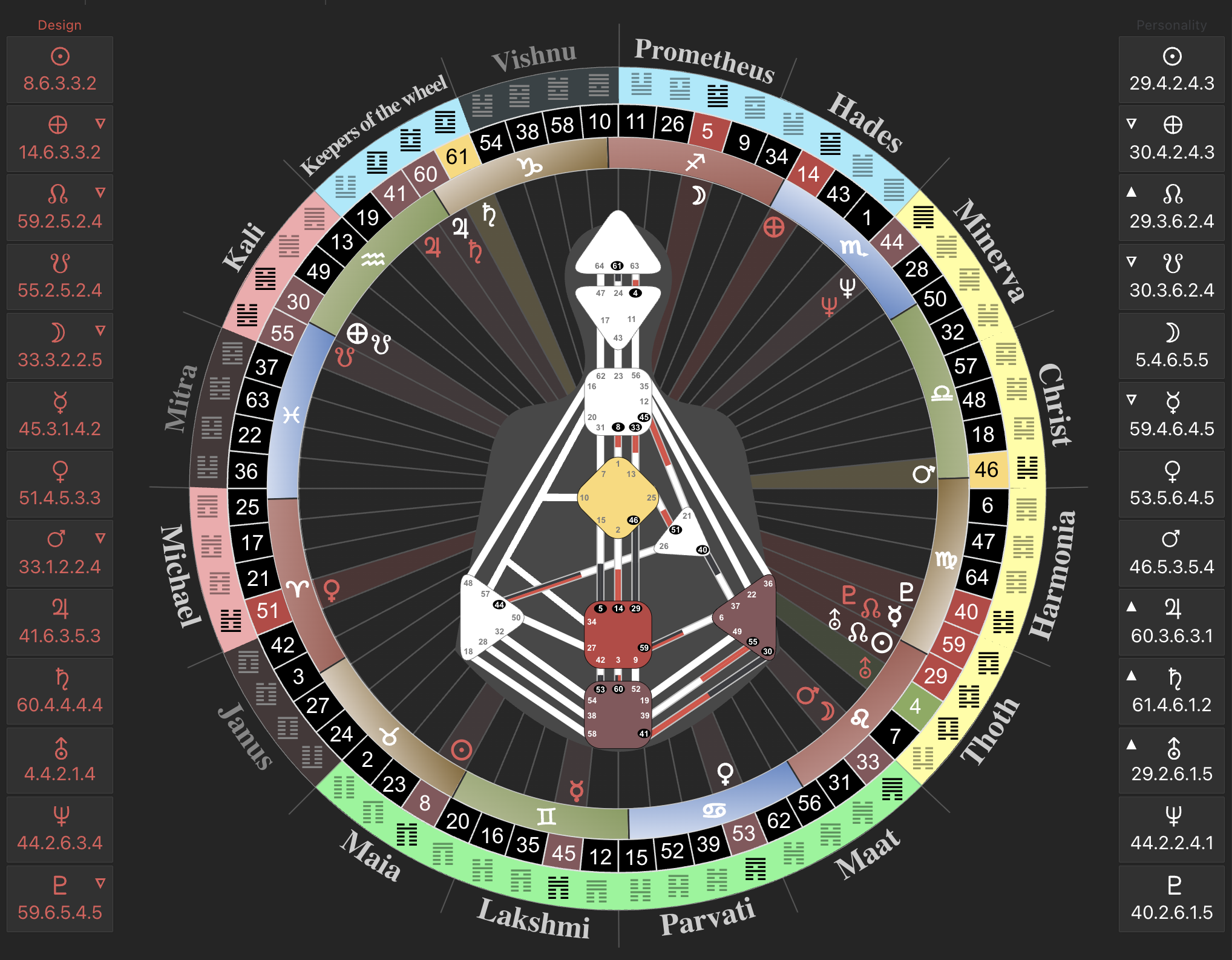
Human Design combines many systems, including Astrology, the I Ching, the Kabbalah, and Vedic Philosophy. It is a vast system that maps nine energy centers overlaid onto your astrological chart. It is intended to deepen personal awareness and support timely decision-making.
I have been deconstructing the system and have become fascinated by the accuracy of the six-line symbols called hexagrams. Each hexagram is a picture of change in motion.
The I Ching describes life as cycles — not fixed states. The six lines show how something grows, matures, and transforms within a full cycle of development:
Line 1 (bottom) – The beginning. The seed. The situation is just starting.
Line 2 – Early development. Adjusting and finding balance.
Line 3 – Friction. Tests. Things become visible and unstable.
Line 4 – Transition. Moving from inner to outer influence.
Line 5 – Peak power. Leadership. The most influential position.
Line 6 (top) – Completion or excess. The energy has gone too far or is about to change.
The six lines mirror natural law. The bottom lines are personal and inner life-oriented. The middle lines represent social interaction, and the upper lines represent collective or spiritual activity.
Here’s how the I Ching’s 6-line structure translates psychologically in Human Design:
Line 1 – The Investigator - Foundation. You need security. Digs deep.
Line 2 – The Natural - Innate talent. Doesn’t try — just is.
Line 3 – The Experimenter - Learns by bumping into life. Trial and error.
Line 4 – The Networker - Influence through relationships. Community bridge.
Line 5 – The Leader/Problem Solver: others project expectations onto this line.
Line 6 – The Role Model - Lives in 3 life phases. Gains wisdom through time
Notice how this mirrors the I Ching developmental arc: Seed → friction → influence → peak → transcendence.
An astrologer will calculate your chart, look at your personality, and design numbers to help you determine your profile lines. The first number = conscious personality (how you see yourself).
The second number = unconscious body energy (how others experience you).
For example, I am a 4/6 in Human Design. My personality line is a 4. I am a natural networker and very relationship-driven. My design number is 6, and I am working toward becoming a role model through understanding systems that provide wisdom and support to others.
If you want to know what your Human Design profile lines are, schedule a complimentary 20-minute session with me for a Free Assessment using your Human Design Chart. Contact me at amber@amberflynn.com or call 760-815-3754 to book your session.